**SEO_TITLE:** The Global Gold Mining Landscape: Key Insights and Trends
**META_DESC:** Discover key trends in gold mining, including production levels, major mining locations, and the implications of rising gold prices. Understand how geopolitical factors are influencing the gold market.
**TAGS:** Gold Mining, Gold Prices, Market Trends, Geopolitical Tensions, Investment Insights
—
## The Current State of Gold Prices
The price of gold has surged dramatically in recent months, driven by geopolitical tensions and economic uncertainty. As central banks globally continue to accumulate gold, the price surged by nearly 60% this year, surpassing the $4,000-per-ounce mark before stabilizing around that level. This rapid increase in value reflects heightened demand, but it also raises critical questions about the sustainability of gold reserves and the concept of “peak gold”—the point at which global gold production reaches its maximum output.
### Understanding “Peak Gold”
“Peak gold” refers to the idea that the world may be approaching the maximum rate of gold extraction. Analysts suggest that global mining production has stagnated between 3,000 and 3,300 metric tons annually over the past decade. While new gold deposits are still being discovered, such as the recent find in China’s Hunan province (the Wangu gold field), most of the world’s gold production comes from older mines that have been operational for decades.
**Actionable Takeaway:** Investors should consider the implications of potential supply constraints on gold prices. With increasing demand and static production levels, investing in gold may be a hedge against inflation and economic instability.
## Major Gold Producing Regions
### Nevada’s Gold Mines
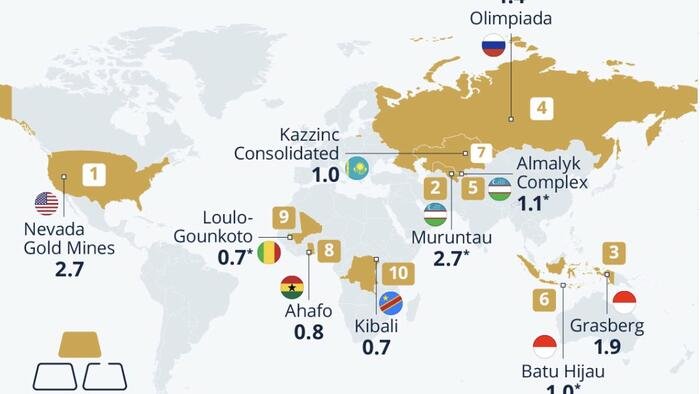
According to recent data, gold mines in Nevada produced approximately 2.70 million ounces (or 76.5 metric tons) in 2024, making it one of the top gold-producing regions globally. This output is comparable to that of Uzbekistan’s Muruntau gold deposit, which has been in operation since the late 1960s and produced around 2.68 million ounces in the same year.
### The Grasberg Mine
Located in West Papua, Indonesia, the Grasberg mine ranks as the world’s third-largest gold supplier, yielding about 1.86 million ounces (or 59 tons) in 2024. Discovered in the 1980s, Grasberg is not only significant for its gold output but also for its copper production, making it a critical asset for the economy.
### Olimpiada Mine
The Olimpiada mine in Russia, discovered in 1975, follows closely with a production of 1.44 million ounces (or 40 tons) in 2024. This mine exemplifies how older sites continue to play a crucial role in meeting global gold demand, despite concerns over resource depletion.
**Actionable Takeaway:** Investors should monitor these key mining regions and their production outputs as they can significantly influence gold market dynamics. Understanding these trends can help in making informed investment decisions.
## The Future of Gold Mining
The ongoing exploration for new gold deposits is essential in addressing the potential for “peak gold.” While some new finds are promising, the reality remains that most of the gold being mined comes from established sources. As geopolitical tensions and economic uncertainties continue to drive demand, the pressure on these existing mines may intensify.
### Implications for Investors
For investors, the current landscape presents both opportunities and risks. The rising price of gold could signal a robust investment opportunity, especially in times of economic instability. However, the finite nature of gold reserves means that long-term strategies should also consider the sustainability of mining operations.
**Actionable Takeaway:** Diversifying investments within the gold sector—such as exploring shares in mining companies, gold ETFs, or physical gold—can provide a balanced approach to capitalizing on the current market trends while mitigating risks associated with supply constraints.
## Conclusion
The dynamics of the gold market are influenced by various factors, including geopolitical events, central bank policies, and mining production levels. As prices continue to fluctuate, understanding the implications of these trends will be crucial for investors looking to navigate the complexities of the gold investment landscape. Keeping an eye on production data from major mines and emerging deposits will be essential in making informed decisions in this ever-evolving market.